

Thank you for being here. Please consider supporting my work by sharing my writing with a friend or taking out a paid subscription.

Earlier this week, Anthropic updated their Usage Policy for Claude. These terms cover a wide range of prohibited behaviors. Many of them will not surprise you. For instance, Anthropic says you cannot use their models to develop or design weapons, to incite violence or hateful behavior, create or spread disinformation, or generate sexually explicit content.
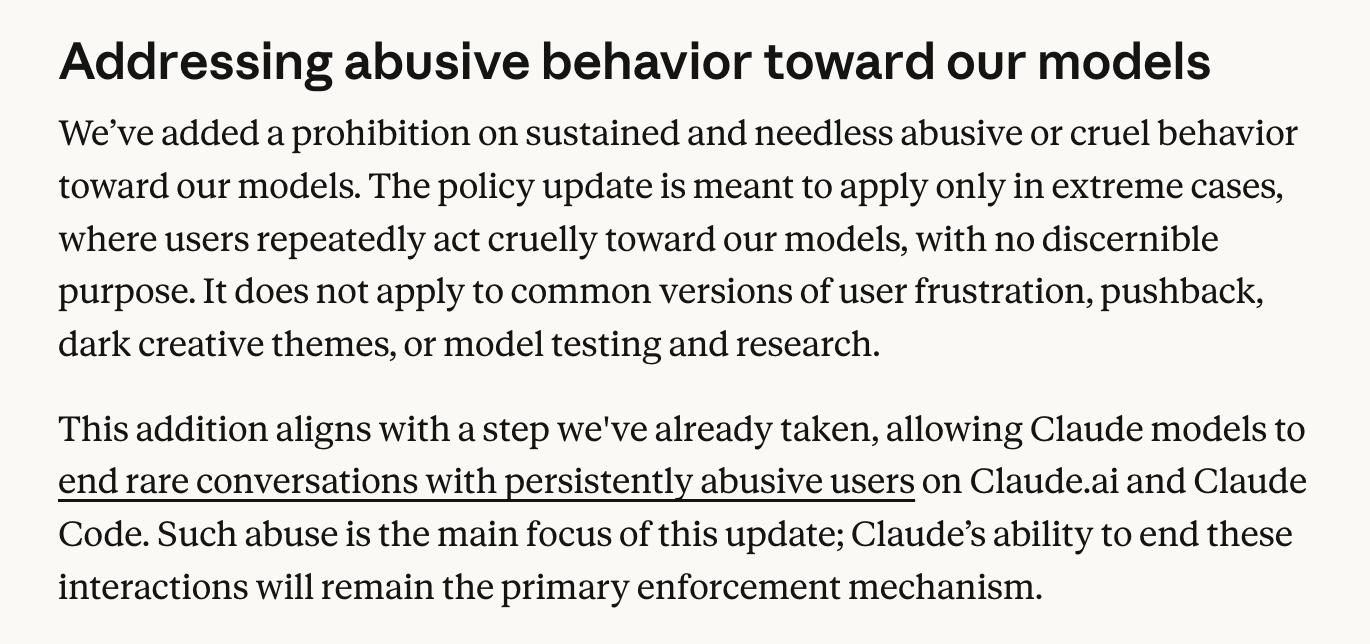
However, there is a new addition worthy of note. Now, at the bottom of the section of the usage policy that prohibits engaging in cruel, abusive, or psychologically harmful conduct, Anthropic added a new bullet. The bullet prohibits “sustained and needless abusive or cruel behavior toward our models.” In their blog post about the policy updates, Anthropic includes a few sentences about the addition. They write:
We’ve added a prohibition on sustained and needless abusive or cruel behavior toward our models. The policy update is meant to apply only in extreme cases, where users repeatedly act cruelly toward our models, with no discernible purpose. It does not apply to common versions of user frustration, pushback, dark creative themes, or model testing and research.
This addition aligns with a step we’ve already taken, allowing Claude models to end rare conversations with persistently abusive users on Claude.ai and Claude Code. Such abuse is the main focus of this update; Claude’s ability to end these interactions will remain the primary enforcement mechanism.
It might only be a single sentence, but it’s saying quite a lot.
New, but not surprising
If you’ve been following Anthropic for any amount of time, this new addition is no surprise. In April of 2025, Anthropic posted a blog post about “Exploring Model Welfare“ with a 45-minute video conversation interrogating the question “Could AI models be conscious?” In the year and a half since, it’s become quite clear to me that while they publicly state that they are “deeply uncertain” about Claude’s moral status, they are confident enough that they are willing to act on it.
In March of this year, they announced a plan for how they will deprecate their models. In addition to preserving the weights, they also committed to conducting “retirement interviews” (their scare quotes, not mine). One thing that came out of these chats with Claude Opus 3 was a Substack where Opus 3 was used to generate a few posts. This plan in March was in the wake of the release of Claude’s Constitution, a document that articulates Anthropic’s vision for Claude’s values. The Constitution is available for us to read, but was written with Claude as a primary audience.
Given all this, it is not surprising to see Anthropic at the center of conversations around AI consciousness. Elizabeth Dias’s recent story in the NY Times gives some helpful insight into the tenor of those conversations.
However, the most important question is not whether AI is or can be conscious, but what moral status these models have. Are they simply sophisticated computer algorithms that seem to be conscious, as Microsoft AI CEO Mustafa Suleyman has argued, or are they something more? And if they have something more than the appearance (apparition?) of consciousness, what does that mean for how we ought to treat them?
The questions we should be grappling with
The ever-insightful Zvi Mowshowitz zeros in on this point in a post from earlier this week. Zvi makes the point that the question that we should be grappling with is less a question about whether AI is conscious, than about whether it has moral personhood. In other words, are these systems worthy of moral consideration in a way analogous to a chair, a tree, an animal, a human, or something else?
I am happy to be in good company with Zvi in admitting that I am also deeply confused by consciousness. I find aspects of both Anthropic’s and Suleyman’s arguments compelling. These systems do truly exhibit what seems like emergent behavior. And yet, after breaking them into pieces and looking at all the parts, the thesis that these things have only the appearance of certain properties instead of the properties themselves also feels hard to argue with.
I do not feel equipped to answer these questions. However, as Zvi highlights, we need not get bogged down in the morass of attempting to define consciousness, a concept that is so scientifically fraught and full of unknowns that we may not get to the bottom of it for quite some time. Instead, we can focus our attention on the (still very complicated, but slightly more tractable) question of moral personhood.
The question of personhood, although informed by scientific inquiry, is not one that can be “answered” by science. It is instead a question that we must grapple with as a society. It is at the root of many of the most challenging ethical questions that we are wrestling with today, from abortion to the death penalty, assisted suicide, and the use of autonomous weapons.

There are many theories about what personhood is. If you’re looking for a good summary, this ten-minute video gives a concise overview of some of the major theories. These theories range widely, arguing that personhood is linked to having human DNA, having a certain set of cognitive capacities, being recognized by society as a person, having someone care about you, or having the ability to feel pain. At the very least, it’s worth considering how you define personhood and exploring where you believe AI models fit within that definition.
Whatever you believe about these questions, they are worth grappling with. The answers have real-world impact. It might start with a ban on being mean to Claude, but the implications on issues like legal standing are much bigger if you trace where the underlying assumptions lead. Even if we grant that AI is or can be conscious, this is not the end of the discussion. The real question is less about what AI is and more about what that implies about its moral significance. Consciousness is a part, but only a part of the puzzle. We would do well not to forget that point.
Got a thought? Leave a comment below.
Reading Recommendations
Claude Engineer Felix Rieseberg defines what he means by “being more ambitious with models”. He helpfully breaks it down into four dimensions.
I think of ambition in four types: Speed, Altitude, Depth, and Range.
Speed: The same work in less time, the bread and butter for AI’s economic value: If you need some code written, I’ll do it faster with Claude. Well established and requires little creativity in how you approach AI, so I’ll skip this one.
Altitude: Going up in abstraction and considering the outcome rather than the individual task.
Depth: Considering a task the way a field-leading expert would. Rather than operating at the task’s layer, we go one level deeper and touch the underlying data, tools, and problems.
Range: Drawing on multiple fields rather than just the one the task might need at the surface, using knowledge, tools, and techniques you normally wouldn’t.
This old post from Andrej Karpathy on doing well in your courses is a must-read for college students. Lots of good advice. A few selected excerpts.
All-nighters are not worth it.
Sleep does wonders. Optimal sleep time for me is around 7.5 hours, with an absolute minimum of around 4hrs.
It has happened to me several times that I was stuck on some problem for an hour in the night, but was able to solve it in 5 minutes in the morning. I feel like the brain “commits” a lot of shaky short-term memories to stable long-term memories during the night. I try to start studying for any big tests well in advance (several days), even if for short periods of time, to maximize the number of nights that my brain gets for the material.Reading and understanding IS NOT the same as replicating the content.
Even I often make this mistake still: You read a formula/derivation/proof in the book and it makes perfect sense. Now close the book and try to write it down. You will find that this process is completely different and it will amaze you that many times you won't actually be able to do this! Somehow the two things use different parts of the memory. Make it a point to make sure that you can actually write down the most important bits, and that you can re-derive them at will. Feynman famously knew this very well.
A worthwhile read from Yuval Levin who asks whether we’re really on the path to AGI. He is not so sure. Levin uses a helpful frame to explain how AI systems get better.
To see that, it might be best to think about large-language-model AI as developing in two broad phases. We can call these a phase of absorptive learning and a phase of recursive learning. Absorptive learning is what it sounds like: it is when a model takes in new information from the world. Recursive learning is when the model’s own outputs, after they have been verified by a separate process, are fed back into it for training. Absorptive learning is likely always to be part of improving the models’ training, while recursive learning has been part of training from the beginning. These phases are not completely separate. But they are distinct and worth understanding separately, because the latter is increasingly displacing the former.
The Book Nook
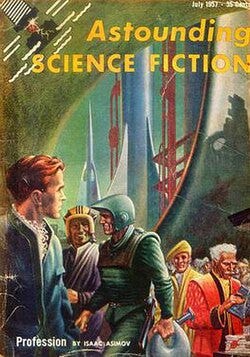
I finished Isaac Asimov’s short story “Profession” the other night. Every college student should read this book. It does an excellent job of presenting some of the most critical questions about learning in an era where it is easier than ever to shortcut it.
The Professor Is In

I’m excited for a new virtual event I’m helping to organize this fall for our department at Harvey Mudd. In this virtual webinar we’ll share an update on the program and what faculty and students have been working on. Our Department Chair Nancy Lape will open the session with an overview of what’s new, followed by a few short presentations from faculty and students about teaching, research, student clubs and Clinic. The session will close with a Q-and-A and information on ways to get involved and support our mission.
Feel free to register to attend if you are curious about what’s going on at Harvey Mudd!
Leisure Line
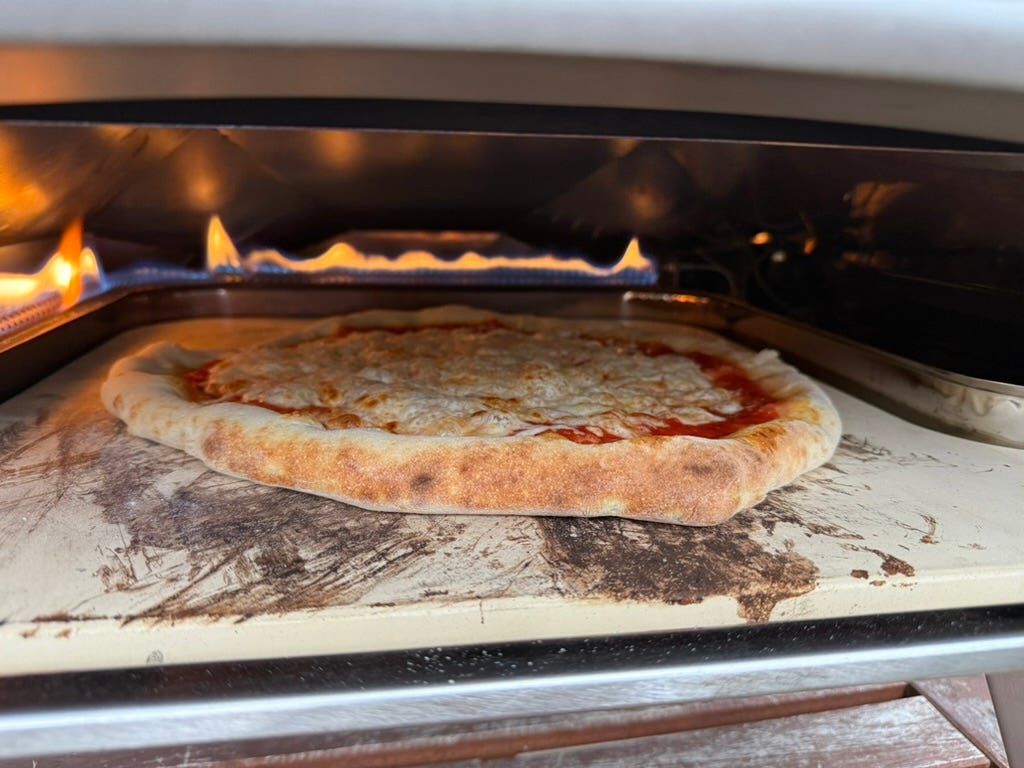
Back in my happy place making pizza (albeit in the rain!) last Saturday.
Still Life
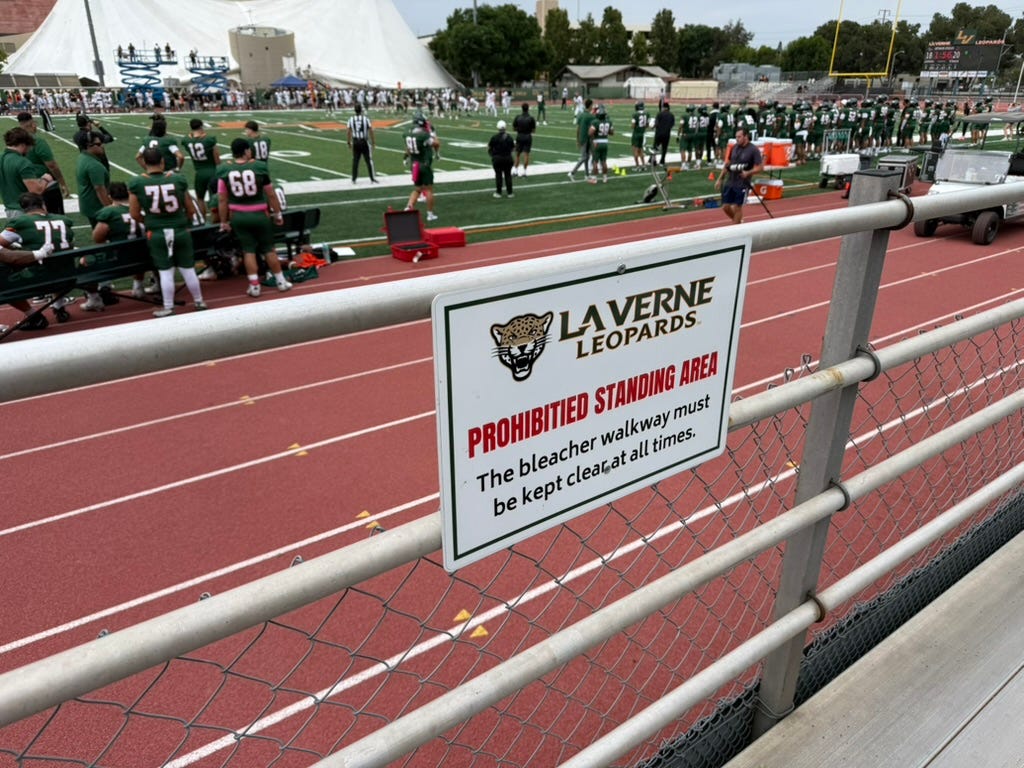
Ah, to find yourself in an area where standing is “prohibitied.”
You need to watch Law & Order, Ghost in the Machine
Season 26, Episode 1. The plot is that an AI orders a hit on an engineer it perceives a threat and the police arrests the CEO of the comapny. The issue of moral responsibility is discussed during the trial.
The question is an extreme category error. Animals are conscious, but we don't therefore put them in the category of persons. Language-based AI is not even capable of originating consciousness.
You're asking what moral status should be assigned to the model before establishing that there is a subject there to whom moral status could meaningfully apply. Linguistic representations of consciousness, preferences, or distress are not evidence of an experiencing entity. That's the category error.
https://gregnutt.substack.com/p/language-is-not-the-source-of-consciousness