
Gather Sun Rays
What Frederick the mouse has to teach us about work, productivity, and AI


Thank you for being here. Please consider supporting my work by sharing my writing with a friend or taking out a paid subscription.
It’s been a busy month and a half in the Brake household. The combination of a lot of travel, some rest and relaxation, and a lot of heads down work in between has meant I haven’t shown up here with a new post in quite a while. But—no longer!
One of my trips over the last month was to Portland, Oregon for our quarterly Praxis Team Gathering. In addition to some time outdoors experiencing the majestic beauty of the Pacific Northwest (photos later in this post), I also happened—serendipitously while walking to dinner one night as fate would have it—to stumble across Powell’s City of Books.
I was already running a few minutes late for dinner, but I couldn’t resist. I looked up at the several story building and walked through the doors. After looking around to get my bearings, I found my way to my favorite section of any book store—Children’s Picture books. And as I began to pore through the books, I searched through the racks hunting for some new-to-me volumes from my favorite out-of-print author, Leo Lionni.
Growing up I was always enamored of Eric Carle. Something about the simplicity and limitations of the picture book format has always drawn me. But as I’ve grown into adulthood, and even more importantly into fatherhood, picture books have taken on even more meaning for me. Great children’s literature is written for children, but it speaks to adults too.
So this week, I want to introduce you to a story from Mr. Lionni. Like all his stories, it has something to teach us. And as I thumbed through it again on the first floor of Powell’s City of Books in Portland last week, I was reminded that these stories often are full of deep wisdom. Wisdom that we are especially of need of in our current moment.
An unproductive mouse
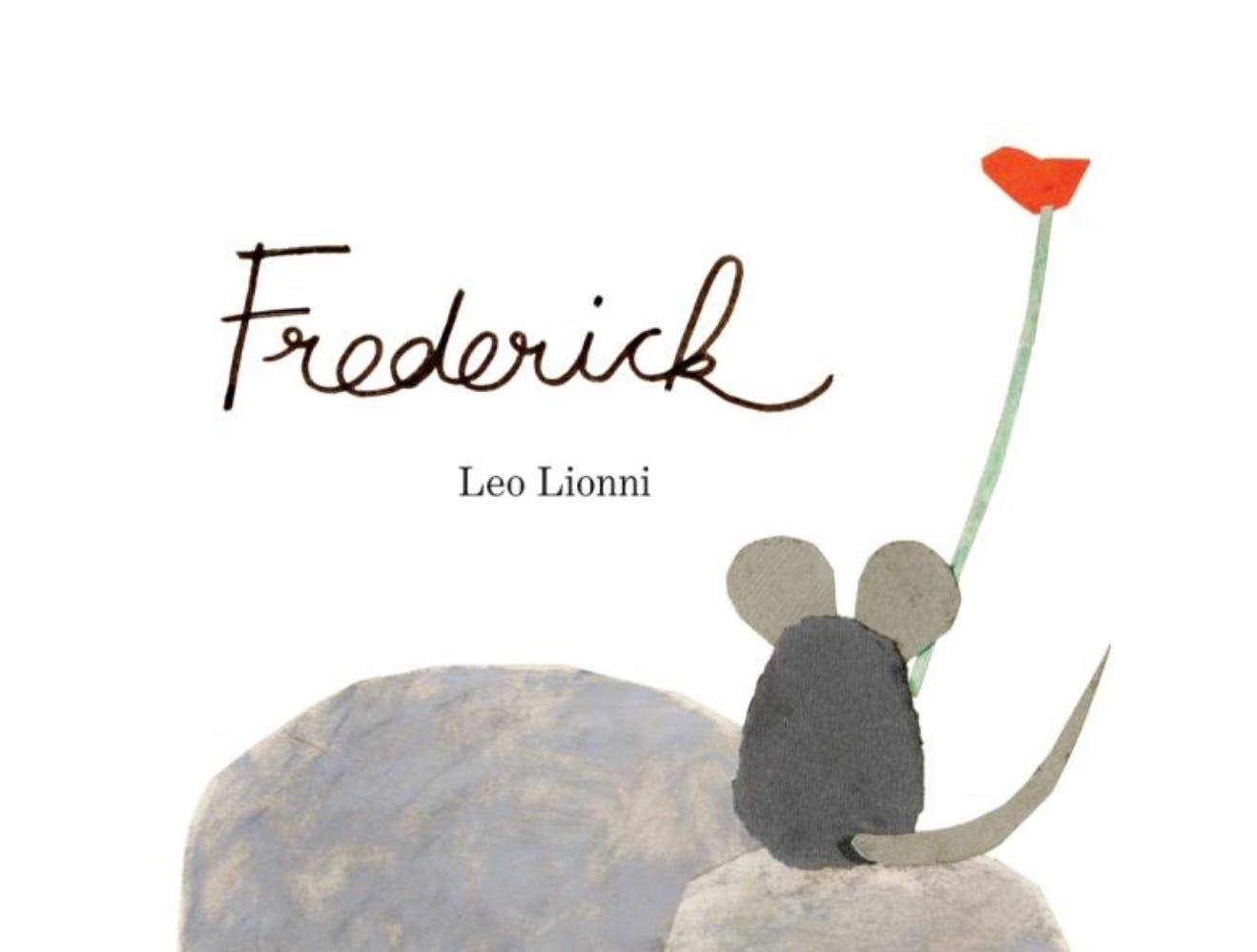
As the story opens, we meet Frederick. Frederick is a mouse and one who marches to the beat of a different drummer, to the irritation of his compatriots.
But, before we go any further, let me read you the story. I’ll see you on the other side.
Frederick’s lesson
As I read Frederick last week—and again, and again, and again as my kiddos have begged me to read these stories to them over the past few days—it struck me that this story has a lesson for us in our current moment with AI.
Much digital ink has been spilled over the past several years about the underlying values that are motivating our use of AI. In most conversations where someone is recommending that you use this or that new AI tool, the selling point is about how it will make you more productive, or more efficient, or more effective at whatever you are trying to do.
There is an element of truth there. AI does make you more productive and more efficient.
But as I was reading Frederick’s story this week, I found myself reveling in Frederick’s apparent lack of productivity. “Winter was not far off,” Lionni writes, and the responsible mice were doing what responsible mice should do: gathering food for the winter.
Meanwhile, there Frederick sat. “Frederick, why don’t you work?” they ask. “I do work,” Frederick replies. They continue to gather food for the winter, grumbling as they go about the increased workload on account of their friend who is gathering sun rays, colors, and words.
Finally winter arrives and the mice are holed up with what they had collected. They slowly make their way through their stores, in mostly fair spirits, until the food is no more. The mood darkens. “[N]o one felt like chatting.” But then they remember. “What about your supplies, Frederick?” they ask.
And then Frederick brings forth from his storehouse: feelings of warmth from the sun rays, beautiful imaginative images from the colors, inviting stories from the words. All of a sudden, Frederick’s contributions become clear in ways the rest of the mice did not expect.

Gather sun rays
In our current moment, the world around us is obsessed, like Frederick’s friends, with being productive. This desire for productive work is not, itself, bad. After all, without the food his friends stash for the winter, the mice would likely not survive.
But Frederick’s story is a reminder that the seemingly productive work is necessary, but not sufficient to live life to its fullest. When the mice reach the end of their rations, it is only then that they turn to Frederick and learn of the value of what is intrinsically less tangible. What looked like laziness in the moment when there was work to be done, satisfied a much deeper yearning in the mice.
As we work in our current moment to grapple with AI and what it means for our productivity, we would be wise to spend at least some time considering what we might learn from Frederick. What does it look like this week for you to gather sun rays, colors, and words? Those acts, while they may look foolish and wasteful now, will likely not always appear to be so.
Got a thought? Leave a comment below.
Reading Recommendations
So much to read since I have been delayed since my last missive… Here are a few quick hits.
The President of UChicago shared what seems to me to be a very balanced and wise approach to AI tools. Some good reflections on it from Stephen Fitzpatrick here as well.
This is a time of rapid change due to the advent of AI, and the University has been thoughtful in navigating it. Indeed, there is inspiration to be drawn from our faculty’s report on AI and Education that calls on us to be skeptical, ethical, and ambitious when it comes to AI, while remaining grounded in the habits of mind and standards of judgment that define this university. In some cases, it is clear that AI tools can be brought to bear with the desired results. In others, we will do better by retaining our previous approaches or even developing new policies to expressly protect against misuse. In all cases, our highest priority in making these tools available is to center our respect and commitment to each individual human being who is part of this community.
An excellent writeup on “How LLMs Actually Work”. Discovering articles like this one is the reason I’m still on Twitter. Here’s the table of contents
Tokens, how a string of text becomes a sequence of integers
Embeddings, how those integers get meaning
Positional encoding, how the model knows what order the tokens came in
Attention, how tokens share information with each other
Multi-head attention, how the model tracks many kinds of relationships at once
The feed-forward network, where a large share of the model’s stored structure lives
The residual stream and layer normalization, what makes deep stacks trainable
Predicting the next token, what the model actually outputs and how the generation loop works
Architecture vs trained weights, what’s broadly shared across modern LLMs, and what’s different

Interesting thoughts on “Who Will Actually Thrive in the Hybrid A.I.-Human Work Force” from a panel including Daron Acemoglu, Dean Ball, Ethan Mollick, Clara Shih, and Bill Wasik. Gift link here.
The Book Nook

Naturally, this week’s book is Frederick by Leo Lionni. It really is a beautiful story, with beautiful artwork to match. Highly recommended for your library, no matter how old you are. Or, if you need an excuse, but a copy for a child you know.
The Professor Is In
I’m prepping for a new class I’m co-teaching this fall with my colleague TJ Tsai at Harvey Mudd College, called AI-Amplified prototyping. The overarching vision for the class is to demystify “AI” by building a generative AI system from the ground up, starting with a basic neural networks, building a simple GPT (riffing on Karpathy’s micro/nanoGPT), wrapping the custom model in an agentic harness, and then building an app around it. The goal at each level of abstraction is to give students the 80% of what they need to understand what’s going on under the hood. Busting black boxes is one of my favorite things to do when teaching!
After building an understanding of what AI is, how to use it, and how to build with it/around it, we will use this process to draw out the questions about the societal impact and host roundtable discussions to interrogate the many challenging ethical questions surrounding AI. It should be a fun time. My hope is that the students come out with a deep understanding of what generative AI is such that they can lead thoughtful and nuanced conversations about AI from a place of deep knowledge and expertise with these systems and their extended impact on society.
Prepping for the class is fun. The past few days I’ve been working on building out a local compute stack to prototype for the class. It’s been quite fun and just one more example of how fun it is to build with technology these days. In just a few days I’ve been able to setup my new NVIDIA DGX Spark and get a local AI model up and running on my desk. Working to build a system around this for the class this fall that students can use to experiment with.
Stay tuned for more!
Leisure Line


Back to some pizza and bread in the past few weeks. Made some of my favorite pies to date in the Ooni last weekend and working on getting my sourdough game up to speed.
Still Life


I had a great time exploring Portland last week, albeit only for a few short days. From a hike in the redwoods in Washington Park, to photos of Mount Hood in the distance, to a stop at Powell’s City of Books, and a morning bike ride along the Willamette River, I got only a taste, but it was a good one!