
Keep Thinking
There's never been a trickier time to do it


Thank you for being here. As always, these essays are free and publicly available without a paywall. If my writing is valuable to you, please share it with a friend or support me with a paid subscription.
Last week Anthropic released its latest commercial for Claude. It's good. If you haven't seen it yet, you should take a minute to watch it.
The ad resonates with me because it highlights one of the central questions about AI right now. In articulating a call to "keep thinking," at least Anthropic understands one of the biggest challenges that generative AI poses. Although they don't come out and say it explicitly, they also illustrate a good trajectory forward.
Thinking, instruments, and devices
While it is still early days, the research is beginning to show that genAI use is not helping us to keep thinking. In fact, in many cases, it is doing the exact opposite. While there are always caveats and valid critiques to be had, the main message of these studies—and many of our anecdotal experiences, if we care to pay attention—is that our natural impulse when using AI is to stop thinking.
This should not surprise us. This tendency to offload work is a fundamental property of technology and one that has been on display ever since we first began creating tools. If you take the goal to be improving productivity or efficiency, then the way our tools limit the amount of effort we need to expend is exactly what we want. Most of the time, this is the criterion we use to judge our tools. They are useful to the degree that they take something off our plate.
However, seen within the larger context, this is only half of the story. As we think about our tools, we need to think not only about how they help us to do something we already do faster, but how they help move us toward the ultimate goal in the broader context.
This is where I commend Anthropic. At least they’ve articulated the right directional end. As we increasingly use AI in our work, we must be mindful to ensure that it enables deeper and more effective thought instead of the opposite. The big question is: how?
If you pay close attention to the ad, you’ll notice something about the examples they’ve chosen to highlight. It is striking to see the lack of screens in the commercial. No smartphones, hardly any computer screens, and certainly no talking amulets with million-dollar domain names.
Ironically, this ad has the vibes of OG Apple ads like their famous 1984 ad for the Macintosh, where Anya Major throws a sledgehammer into the screen showing propaganda to its viewers. Meanwhile, today Apple is crushing the tools of human creativity to create super-thin iPads and laughing about how Apple Intelligence (when/if it works) is helping you to rephrase your angry emails. As if the only thing going on is that AI is “rephrasing your tone” like the title of the ad suggests.
The source of the distinction between these two takes on AI is the difference between seeing this new technology as an instrument vs. a device. This contrast between instruments and devices is a central part of my friend Andy Crouch’s book The Life We’re Looking For. There, he extends (in much more accessible prose, I must add) what philosopher of technology Albert Borgmann calls the device paradigm.
In his book Technology and the Character of Contemporary Life, Borgmann argues that technology can either encourage or discourage what he calls focal practices. Borgmann uses the example of a hearth at the center of a home as compared to a furnace tucked away in the recesses of the basement.
[A] stove used to furnish more than mere warmth. It was a focus, a hearth, a place that gathered the work and leisure of a family and gave the house a center. Its coldness marked the morning, and the spreading of its warmth the beginning of the day. It assigned to the different family members tasks that defined their place in the household. The mother built the fire, the children kept the firebox filled, and the father cut the firewood. It provided for the entire family a regular and bodily engagement with the rhythm of the seasons that was woven together of the threat of cold and the solace of warmth, the smell of wood smoke, the exertion of sawing and of carrying, the teaching of skills, and the fidelity to daily tasks.
Compare this vision of the hearth with that of the furnace. As Borgmann describes elsewhere, the furnace extracts a single property of the hearth—heat—and seeks to make it more efficiently generated. When you do this, you get what you ask for. That is, you get more efficient heat generation. But focusing on what you get must also be balanced by an analysis of what you lose. What you lose, using Borgmann’s words, is the center of the house.
In contrast, take the framing of what Andy calls instruments.
There is a kind of technology that is easily distinguished from magic—a kind that involves us more and more deeply as persons rather than diminishing and sidelining us. This kind of technology elevates and dignifies human work, rather than reducing human beings to drones that do only the work the robots have not yet automated. It does not give us effortless power but instead gives us room to exert ourselves in deeper and more rewarding ways. This technology uses the abundant sources of energy (ideally renewable ones) available to us and the cybernetic control systems we have invented, not to replace people but to further involve them in creative work in the world.
Instruments extend the core capabilities of the humans they are designed to serve rather than commodifying only a particular aspect of the experience. They are built with an eye toward how it might form and deform the experience surrounding it.
Consider how a Solo Stove uses clever engineering to preserve the bonfire experience while drastically reducing the amount of smoke that is generated. This is an instrument. The design embodies a certain understanding of what the goal of the bonfire is. The goal is not just to create heat or even to generate a flame over which to roast marshmallows. It is designed to create a certain experience, the shared joy of gathering together in the summer to spend time together as the evening fades to night.
Perplexed by Perplexity
A focus on building instruments is rare. That’s because it still requires effortful human engagement. And effortful human engagement is hard.
Last week, I decided to check out Perplexity’s agentic browser, Comet. The main idea behind Comet, and other tools like it (e.g., Dia or ChatGPT Agent), is to tightly integrate an LLM with your web browsing experience. Instead of just having an LLM window alongside your browser, what if you hooked the LLM directly into your browser and allowed it to take action, clicking on buttons and filling in fields?
I logged in, downloaded the browser, and fired it up. Shortly thereafter, I received an email welcoming me to Comet. I’m suspicious that somewhere they figured out that I am an academic, funneling me to the academic welcome email.
The copy at the top of the email welcomed me. “Comet is your personal assistant, study buddy and tutor. Our goal is simple: help you get your work done faster while getting better grades.” Obviously, the intended audience here must not be the professors trying to help the students work more slowly and thoughtfully. You know, to actually learn something instead of just getting your work done “faster.” As if doing anything faster or more efficiently was an end that justifies itself.
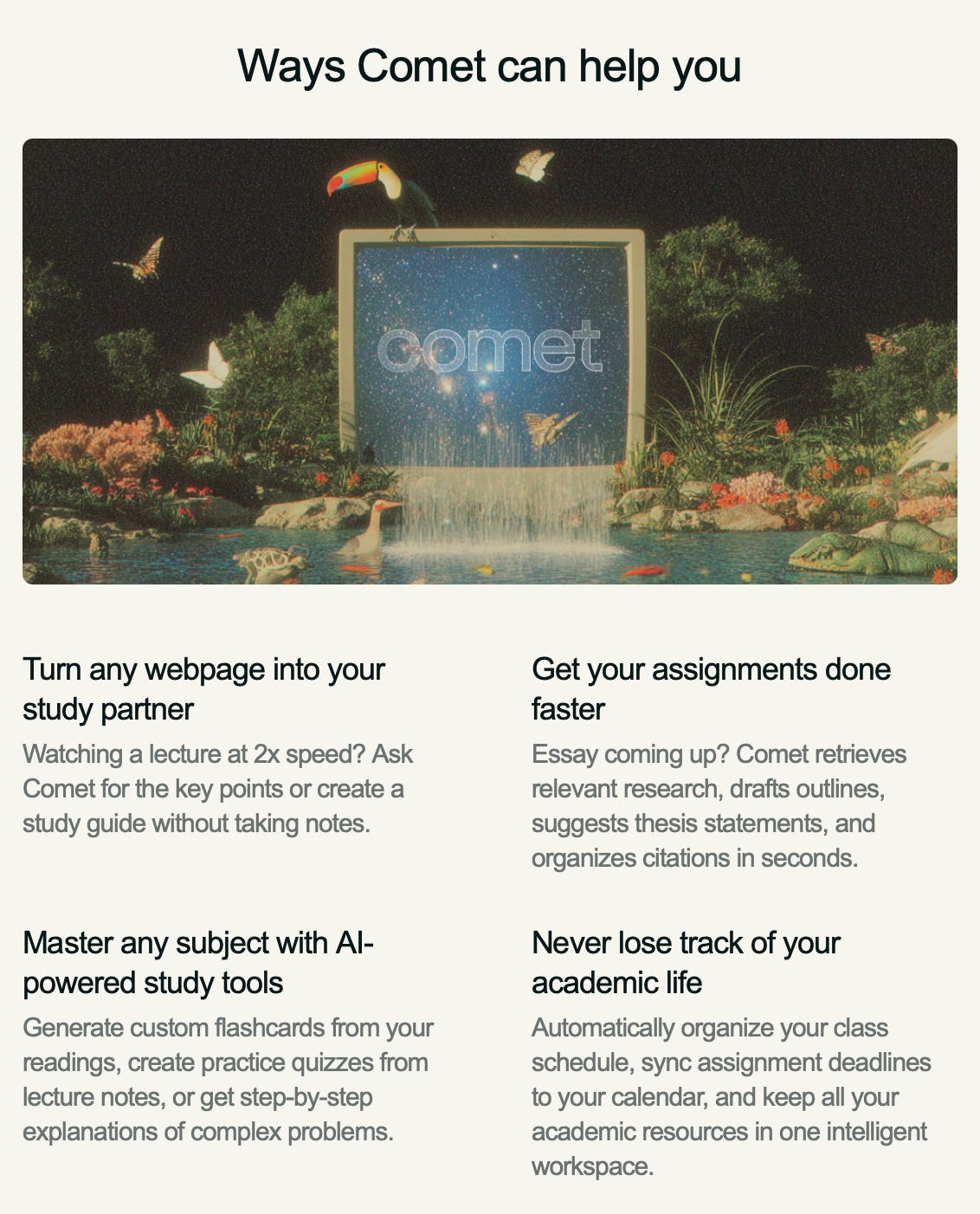
Listen, I don’t want to bash on Perplexity too hard, but they kinda asked for it here. This is exactly why those of us trying to do the hard work of helping our students engage with meaningful and hard material don’t like y’all. This is not helpful, and it’s not in the best interest of our students.
Listen, I understand the impulse of wanting to go faster. We all have lots to do. But if the goal is trying to get better grades by expending as little effort as we can, we are lost. This is not and cannot be the goal of education. All fine and good if we are trying to help students engage more effectively with their work. I’m even fine with engaging more efficiently if the time we’re saving is time that’s not really worth spending at all. If it’s parasitic friction we’re eliminating, then great. But let’s not eliminate the productive friction along with it.
The challenge and opportunity for educators
What we need from this new set of LLM-enabled tools is not new ways to commoditize the products of our thought, isolating the heat of our hearths and seeking to make it ever more efficiently produced. Instead, we need instruments. We need a set of tools that, once we identify the core value of the things that we are doing, help us to more productively and effectively engage with the work we are doing. We need instruments—rooted in a deep understanding of the dignity of the human person and her work—that encourage us to more deeply embody creative practices as we seek the flourishing of our neighbors and our world.
I cannot think of a more exciting and challenging time to be an educator. If you watch the Anthropic ad again, you’ll notice that it is full of instruments. The humans in the video are making music, building electronics, analyzing data, exploring space, fixing bikes, and processing medical data. They’re not sitting in front of a computer letting their LLM-equipped browser do their homework for them.

There is a fork in the road. We can choose. Want to keep thinking or stop? Want to build instruments or devices? Want to engage in the frictional process of learning and work or chase superpowers?
This problem is a challenging one. At the same time that we might desire to keep thinking, we face the prospect of our tools increasingly tempting us to shut off our brains. C. S. Lewis articulated it well in The Abolition of Man when he wrote:
And all the time—such is the tragi-comedy of our situation—we continue to clamour for those very qualities we are rendering impossible. You can hardly open a periodical without coming across the statement that what our civilization needs is more 'drive', or dynamism, or self-sacrifice, or 'creativity'. In a sort of ghastly simplicity, we remove the organ and demand the function. We make men without chests and expect of them virtue and enterprise. We laugh at honour and are shocked to find traitors in our midst. We castrate and bid the geldings be fruitful.
If we are to find our path forward, we’ll need more than just powerful AI tools and a bit of optimism. To keep thinking, we’ll need in ever greater quantity the things that AI cannot provide us: deeply cultivated habits of mind, practices of self-reflection and observation, and virtues like integrity and humility.
In the age of AI, these aspects of human development must be our focus and a core part of the college experience. Keep thinking, my friends. Not just with AI, but about how the AI tools themselves may be challenging your ability to do that very thing.
Got a thought? Leave a comment below.
Reading Recommendations
I enjoyed revisiting this piece from Hollis Robbins (@Anecdotal) from a few months ago, where she entertains the thought experiment of sending Claude to school.

This piece from the NY Times titled “Finding God in the App Store” by Lauren Jackson (gift link) should give us all pause, whether we are religious or not. We seem to be rushing headlong into a reality where we are staring into the LLM mirrors and finding ourselves deeply confused about what we see.

In what I am tallying as another +1 in Anthropic’s column, Simon Willison writes in his blog about a definition of AI agent that he feels is stable enough to be useful. Namely, “An LLM agent runs tools in a loop to achieve a goal.” This makes sense to me and feels very reasonable and accurate. What is most helpful here is that there is no ghost in the machine of Sam Altman’s showmanship that talks about AI agents as if there is another human-like intelligence in the box “doing work for you.”
The Book Nook

This week, I spent some time reading Elton Trueblood’s The Idea of a College. I really like Trueblood. This book did not disappoint. Here are a few quotes that resonated.
The place to begin in our educational philosophy is a change in purpose. We must make our goal, not adjustment, and not even happiness, but excellence. We may, indeed, achieve happiness in this way, but the happiness will come as a by-product rather than something at which we have directly aimed. Young people who begin to have a taste of what excellence in performance and production may mean often discover that this brings a joy and satisfaction which are not known in mediocrity, no matter how much entertainment is provided. Though many students of today do not know it by experience, the truth is that the joy to be found in writing a good essay, striving for genuine competence rather than for a passing grade, is a great joy. This is because man is made to be a producer. We are happy when we make, and we are happiest when we make at the level of excellence.
The central point to keep in mind is that a person is not merely an engineer or a lawyer, but primarily a man. In the long run the kind of technician a person is depends upon the kind of man he is. The purpose of an educational system, as John Stuart Mill said in his inaugural address as rector of St. Andrews University, is to make “capable and cultivated human beings. Men are men before they are lawyers or physicians or manufacturers; and if you make them capable and sensible men, they will make themselves capable and sensible lawyers or physicians." The motive of practical achievement is sound and trustworthy, but the task of educators is to enlarge students' conceptions of what adequate or self-justifying achievement may be. Our task is not to neglect the powerful incentive of vocational education, but to enlarge it.
The Professor Is In

Hard to beat this view of the Manhattan skyline from the top of the roof of Praxis’ office building, Coram Deo, in New York. A full three days in NY with the team—full not just of work and time together, but of joy and laughter.
Leisure Line

The kids were thrilled last Wednesday, on their first day of their homeschool co-op, to be welcomed into the Owalla club. We are officially an Owalla family.
Still Life

A shot from the backside of Saint Mary’s Lake during a brief pause in my run yesterday afternoon on the campus of the University of Notre Dame, where I’m spending a few days to participate in a conference on AI, Faith and Human Flourishing.
Bait n switch. Marketing tactic. Do you think Apple ever gave a shyte about us crazy ones? As Mailer would have said, keep your shyness detector tuned n operational.