
Learning To Draw The Line
Why you should consider reevaluating your work this fall through the lens of Slow Productivity

This week, as we approach the end of summer and the start of the fall semester, I want to spend a little bit of time exploring how a concept called Slow Productivity from one of my favorite writers and thinkers Cal Newport might help us to think about our work differently, inspired by a few essays and podcasts that I encountered this past week. By the end, I hope you’ll come away with a realistic assessment of your limitations and a few ideas about how to prototype a new relationship with time and your to-do list this fall.
The work that matters most is measured on the scale of years and decades, not days and weeks
Cal Newport has long been one of my favorite voices in the self-help and productivity genre. One of the main reasons I love Cal’s work is that he focuses on the why, not just the what. This way of thinking is encapsulated in the idea of “the deep life.” The pursuit of a life of depth goes beyond quick fixes and has to acknowledge root motivations and structures, addressing both the individual and group dynamics at play.
While I think Cal’s writing is valuable for anyone looking to develop a deep life, his work is especially valuable for knowledge workers. His books, from Deep Work, which unpacks how to think through your work habits to prioritize the type of creative work that is at the heart of much of knowledge work, to Digital Minimalism, which argues that we need to reset our relationship with our devices and provides a roadmap for how to chart a new path forward, I’ve long thought that Cal has his finger on the pulse on a vision for flourishing in the knowledge economy.
Lately, Cal has been writing and thinking a lot about a concept he calls Slow Productivity. In many ways this is the natural next step in his thinking, weaving threads from So Good They Can’t Ignore You with ideas from Deep Work. So Good They Can’t Ignore You argues that you need to develop rare and valuable skills that you can leverage to create the career you want and Deep Work helps to chart the practices to help you do that. The concepts in Digital Minimalism and A World Without Email help to plot a course for using your personal devices with intention and recognizing the importance of systems and structures for managing work in collaboration with others. Together, these early books lay the groundwork for Cal’s core goal of Slow Productivity: To keep an individual worker’s volume of work at a sustainable level.
Cal’s argument is that ultimately, the reason we feel stressed and burned out at work is that we don’t know how or where to draw the line. We naturally fill our cups too full, saying yes to about 20% more than is a sustainable level of work for us. Naturally, the compounding impact of this extra 20% of work leads to stress as the pile of undone work continues to pile up and swamp us.
The choice isn’t if but where we draw the line. Ultimately we (and our time) are finite. We all have only 168 hours in each week. We have no choice but to draw the line somewhere. The question is how we learn how to draw our lines. Unfortunately, for many of us, we aren’t taught how to do this well, relying on societal expectations and cultural norms. There must be a better way.
An opportunity for decluttering
So what do we do? Saying “no” is hard. With even a little bit of self-reflection, I can see this cropping up in my own life. I’m always seeing something else I want to do, one more class to teach, project to start, blog to write—adding and adding to the pile.
This fall, I’m planning to (re)learn how to draw the line in my life. What are the things that are most important to me on the scale of decades? What are my career goals? What are the activities that bring me energy and those that sap it?
The cold hard truth is that just like a garden, we regularly need to prune back the overgrowth in our lives, doing a Marie Kondo-style declutter. The end of summer, especially for students, is a great time to do just that.
Ignore the fluctuations and focus on the average pace
We desperately need to learn how to judge our own capacity and develop the ability to draw the line. Fortunately, the nature of building things that matter helps here. Because the work that matters most happens on the scale of years and decades, not days and weeks, we don’t need to sweat the effort of each individual day nearly as much as we often do. It’s a cliche, but the stuff that really matters is a marathon, not a sprint. No sense in burning out on mile 5. As the NAVY Seals say, slow is smooth, and smooth is fast.
In view of the long game, the ups and downs of our everyday work experience are less important. Any individual day where you kill it at work doesn’t really move the needle much. Likewise, a day where you feel like you got swamped and didn’t get anything done is also a small speed bump in the grand scheme of things. The fluctuations of any one day just don’t hold much weight.
Instead of the intensity of any one effort, it’s the overall accumulated progress that matters most. It’s about the area under the curve. This suggests a different optimal strategy to make the most progress toward one’s goals in life, one that prioritizes endurance over max effort productivity. Counterintuitively, by drawing the line so that we cut out that extra 20% that is burning us out, we actually will accomplish more in the long run.
The four-hour work day
This train of thought this week was prompted by a recent episode on The Deep Life, Cal’s weekly podcast. In this episode, Cal spends some time reflecting on his takeaways from a recent essay from Oliver Burkeman’s email newsletter provocatively titled “The four-hour work day.”
In the essay, Burkeman, the author of the New York Times bestseller Four Thousand Weeks: Time Management for Mortals, describes a recent experiment he conducted when he felt overwhelmed with the amount of work on his plate. He writes:
Something I’ve long understood about myself is that whenever I get stressed about the number of things on my plate, or anxious about the challenges of a specific project, it’s an excellent idea to do the opposite of what comes naturally to me. What comes naturally is to bear down hard on the work, in an effort to get through it: to get up earlier, skimp on exercise, cancel social occasions, etc. Whereas what works – for my soul, sure, but more interestingly for my productivity too – is to keep working at a moderate pace, leaving plenty of time for hiking, sleeping, socialising and so on.
And so, recently, when I felt myself on the brink of overwhelm again, I thought I’d try pushing this principle one step further. It had started to feel as though even 20-hour workdays would be insufficient, frankly, to get a handle on my to-do list. So… what if I were to deliberately limit myself to a preposterous, clearly insufficient four-hour workday instead?
It’s a thought-provoking article and it’s well worth your time to read the whole thing, but what stood out most to me was the way he highlighted the importance of addressing the psychological impact of our work. It’s not just about the tasks themselves, but the mindset through which we approach them and the structures we use to organize them.
At the end of the day, we all have more on our plates than we can get done in the time we have available. The choice is one of prioritization. What’s most important?
Learning to draw the line
I’m writing this week, as always, as much to myself as to you. Learning what is enough is hard. Finding that extra 20% of stuff to cut out isn’t always easy. But I’m convinced that this is work worth doing in order to help us to flourish, both at work and at home. I hope that you’ll join me in spending some time to list out all the activities on your plate and decide which are most important and which you may need to step away from, at least for a season.
The Book Nook
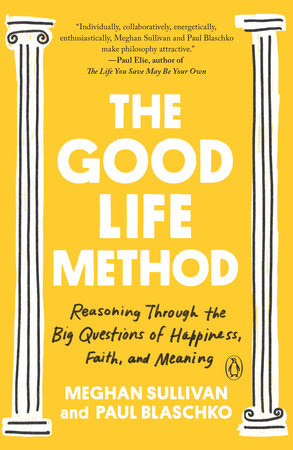
This week I’m digging back into The Good Life Method by Meghan Sullivan andPaul Blaschko. This book came out of a course that Meghan and Paul developed and now teach at the University of Notre Dame called God and the Good Life.
The course, which is offered to over 1000 students at Notre Dame each year helps students to wrestle with the big questions in life and approach them using philosophy as a way of life. Each of the four units in the class, ethics, belief-formation, religion, and meaning, is organized around questions.
I’ve been enjoying the book so far and appreciate the way that Meghan and Paul invite readers into philosophy through the lens of curiosity. I’m sure I’ll have more reflections to share as I get deeper into it!
The Professor Is In
This week I’m working on preparing a talk for the Optica Computational Optical Sensing and Imaging (COSI) program which will be hosted as part of the Optica Imaging Congress next week. My talk is titled "Interferometric Speckle Visibility Spectroscopy (ISVS): Leveraging Commercially-Available Cameras to Sensitively Measure Flow Dynamics Inside Scattering Media.”
The talk will focus on sensitively measuring the properties of optical speckle patterns. The temporal dynamics of these speckle patterns encode valuable information about the underlying dynamics of the particles within a scattering medium (like blood flow in biological tissue). I’ll share a bit of background about why I love (and am a bit obsessed with) optical speckle and also demonstrate how interferometric speckle visibility spectroscopy fits within the ecosystem of techniques that can measure changes in blood flow speed deep in biological tissue.
Leisure Line

This week I unveiled a new website at phdpies.com. Right now the website is primarily a page with gear recommendations for making pizza at home and a few recipes and other resources, but I’m planning to keep filling it out as time goes on with more recipes, tips, and tutorials. I’ve also got a new Substack up at PhD Pies that you should subscribe to if you are interested in getting some pizza details straight to your inbox a couple of times a month! I published the first post yesterday.

My plan is to post less regularly there than the weekly cadence I shoot for here. Here’s a snippet from the first post over there in case you’re curious about what I’m planning…
Welcome to the inaugural issue of PhD Pies! This is a prototype in progress but my plan is to try to publish a new post once or twice a month. To start, I’m planning to organize it into a few main sections:
Pizza Feature: A few photos of my recent creations.
Gear Highlight: A piece of pizza-making gear that I love and you might consider adding to your arsenal.
Recipe Time: A recipe to share for either dough, sauce, or pizza topping combinations.
Fan Photos: I’ll need your help with this one. I’m hoping to feature photos of you making pizza. So send ‘em in. You can either email them to me directly or upload them to social media and tag PhD Pies (@phdpies on X/Twitter, Instagram, or @joshbrake on Substack Notes)
Still Life
It was a baking kind of weekend. I made a from-scratch vanilla birthday cake for #2’s second birthday and a batch of croissants. Boy do the croissants take a lot of effort (24 hours worth of prep), but I am pretty pleased with how they turned out!


Great post Josh. Never heard that Navy Seals quote but its so true. I've really liked Cal's idea of slow productivity as its an actual answer to some of the challenges of modern life.
Decluttering goals is a focus of mine for 2023, so this one really resonated.