


Thank you for being here. Please consider supporting my work by sharing my writing with a friend or taking out a paid subscription.

AI is dominating the headlines across many disciplines, and education is certainly no exception. Ever since the release of ChatGPT, there have been a wide range of arguments: for some, generative AI is the end of education as we know, undermining the very foundation of what education is for. For others, it is opening up new opportunities for a learning renaissance.
As usual, the reality is complicated and highly context-dependent. I have been knee-deep working with these tools for the past few years, and am experiencing firsthand how AI can provide new opportunities for teaching and learning. It has radically reshaped the way that I do my work as an educator, from the way that I brainstorm new ideas, design my courses, and create material for my students. It has enabled me to create materials to engage my students in more active, experiential learning. It has allowed me to extend my expertise as an educator and become a better one.
For context, let me say a bit about some of how I’ve been using AI this semester in developing new class I’m co-teaching. The new class, AI-Amplified Prototyping, is designed to teach students the fundamentals of how to build an AI-powered app from the ground up so that they can understand what is going on under the hood and critique the design and societal impact of these applications grounded in a deep understanding of how they work.
We began the class with neural networks, starting with fitting linear models using gradient descent, building and training a dense neural network, training a generative pre-trained transformer, and building an agentic AI harness. Quite a whirlwind tour over the first four weeks. Today, we are turning the corner and will start a new section of the course, discussing how to build web applications. We’ll cover databases, servers, frontends, and deployment before students design and build a final project that incorporates what they’ve learned from each of these threads.
How I’m Using AI This Semester
Anyone who has created a new class from scratch knows that it is a tremendous amount of work. Deciding what to cover and what to skip, creating assignments, writing lectures, and planning out what to do during class time—all told it takes roughly an order of magnitude more time than subsequent iterations of an existing class, at least to do it well.
After coming up with the general outline for the course with my co-instructor this summer, we have been experimenting with how generative AI tools can help us execute on the vision. For example, my co-instructor used Claude to modify materials from another class he teaches on machine learning, tailoring the resources to this particular course. Using tools like Claude has helped us build and test a series of lab exercises using scaffolded Jupyter notebooks, design interactive in-class activities, create diagrams to illustrate key concepts, and create quizzes.
We’ve also experimented with how to invite students in the class to experiment with AI as well in their own learning. Given that the class is an elective class focused on AI, it’s only natural that students in the class are already curious about AI and interacting with it in various ways. But instead of prohibiting AI or having an open AI policy, we’ve carefully prescribed the way that they interact with AI to help maximize the alignment between their AI use and their learning. For example, students are allowed to use AI to get assistance on their labs and to prep for quizzes, but only using a custom AI platform I built. The platform allows us to create custom AI models where we can tailor the system prompt and attach relevant materials so that students can ask questions to deepen their understanding or to clear up confusion without giving away the answer.
We’ve also been thoughtful about how we assess students’ work in the class. Each week they complete a scaffolded lab assignment, but completing the lab is only used to preparation for a 15-minute oral check in with an instructor each week. In these check-ins, we discuss the key concepts in the lab with each student, asking them a series of questions to probe their understanding and help them to get feedback on the concepts that they understand well and the areas they are shaky. While this kind of individual check-in with instructors doesn’t scale well to larger settings, it’s not hard to imagine how you might train a group of TAs to divide the class to support individual check-ins for larger classes. In addition to the in-person check-ins, students also complete handwritten quizzes in class each week where they are asked to respond to questions that cover the course content for the week.
Overall, this approach has allowed us to give students the agency to explore how AI might be used to aid their learning (so far the feedback from students has been positive), while also removing the incentive to just fly through the lab assignments each week without really understanding them because you’ll need to sit down with an instructor to explain what’s going on.
A few months in from the first conversation about this course, it’s clear to me that the availability of generative AI tools like Claude Code has made this course much fuller and more engaging than it would be otherwise. Claude has enabled us to extend our pre-existing expertise to create tailored learning materials much more rapidly than we would have been able to otherwise, executing on our ideas more quickly and freeing us up to be more creative and to spend more time in conversation with the students in the course. It’s also played a critical role in helping us to deliver on the flipped architecture of the course, enabling us to rapidly prototype and build engaging in-class activities, something that the literature on effective pedagogy has shown to be an effective strategy, but is much more time consuming to create than conventional lectures.
Build Fireplaces To Support Focal Practices
As I’ve been reflecting on how AI has enabled this new way of curating and creating course materials, I’ve been reminded of the ideas of philosopher of technology Albert Borgmann, who argues that we ought to build what he calls focal practices and warns us of the ways that technology can prohibit their formation. Borgmann diagnoses the problem with an idea he calls the device paradigm, contrasting the metaphors of a fireplace vs. a furnace.
Unlike a furnace, which often sits tucked away in a closet or basement, a fireplace is often in one of the main living areas in a home. It provides not only heat when the weather is cold outside, but a focal point within the home—a place where a family can gather and spend time together.
Here Borgmann is highlighting the way that technology is commoditizing. It takes a certain measurable good which is produced as one aspect of a process, isolates it, and then makes it more efficient. Seen from the perspective of producing heat, a fireplace and a furnace are doing the same thing. But the fireplace creates a certain environment within a home. The furnace simply extracts on dimension of what the hearth is, makes it more efficient and effective on that single dimension, and ignores the rest.
As think about generative AI in education, we might analogize generative AI as a method of combustion. At its heart, it is a set of tools that allows us to transform an input into an output, similar to how a fireplace converts wood (or a furnace converts gas) to heat.
At the end of the day, it’s up to us to decide what we want to do with this technology. Do we want to use it to create ever more efficient ways to commoditize a specific aspect of our work, making it easier, cheaper, faster to create? Or do we want to use it to create more effective fireplaces? What if the leverage provided by generative AI can be used to create more embodied, human learning experiences? To be more curious, creative, and expressive in our endeavors?

It is a narrow path to walk and it is easy to fall off on either side. The default may indeed be for generative AI to encourage our students to develop a narrower and instrumental view of their education. But generative AI didn’t create that problem, it simply accelerated the endgame. The choice ahead of us is whether to throw in the towel and resign ourselves to that end or to double down on our creativity and ingenuity to create more engaging learning environments for our students. It would be a mistake to dismiss generative AI without any curiosity for how it might help us to create new, more effective learning experiences for students. Whether we use generative AI or not, let’s focus on making fireplaces that encourage focal practices, not furnaces that undermine the very conditions needed for them to exist at all.
Got a thought? Leave a comment below.
Reading Recommendations
I just can’t stop watching this video of Kelly Clarkson’s absolutely nailing this track to the wall. My goodness.

Dartmouth Professor of Mathematics Dan Rockmore wonders for The New Yorker, “Should the Classroom Be More Like the Gym?” Why yes, yes it should. The piece is good.
The great challenge of teaching is not to transmit information—machines do that cheaply now—but to engineer those moments of genuine understanding reliably enough that students come to crave them. The intellectual equivalent of the body’s feedback is real and, when it arrives, more powerful than any endorphin. It is the “Aha!” of a hard problem suddenly solved, a proof that clicks into place, the moment when an argument you’ve been wrestling with finally holds its own weight. I have seen it on students’ faces, and there’s nothing quite like it.
Lots of thoughts similar to what Cal Newport wrote earlier this year in the New York Times.
The Book Nook

On the recommendation of a friend, I’ve been reading C. Thi Nguyen’s book The Score lately and really enjoying it. Motivated by his love of games, Prof. Nguyen unpacks how games work and wonders about how they can be used to shape our desires. I’m still only partway through, but finding lots of thought-provoking ideas, especially connected to the structure of grading and school.
The Professor Is In

Boy, what a re-entry from sabbatical it has been. In addition to being back teaching the embedded systems class that I’ve taught every fall I’ve been at Mudd (and co-teaching it this year with one of my colleagues!) It’s been great fun to build and co-teach AI-Amplified Prototyping with a colleague.
As I wrote briefly about in the main essay this week, the basic idea is to help students construct a concrete understanding of what AI is so that they can thoughtfully build with it and interrogate its societal impacts. We started the semester with gradient descent as a way of fitting simple linear models, spent a week talking about dense neural networks, and this week are discussing how attention, Generative Pre-trained Transformers, and Large Language Models work. Next week we’ll discuss harnesses before we turn to a module on how web applications are built and deployed. Afterwards, students will propose and work on a final project of their own design.
Alongside the technical content in the class, we are also facilitating discussions around the societal impact of AI. In class on Wednesday, following a lecture on the post-training process, we had students work in small groups to analyze different AI companies and their mission statements, exploring how that might impact how their models are trained. I’ve also been hosting a series of Friday lunch discussions on various topics related to AI. Last week we talked about Sherry Turkle’s recent Atlantic article. This week we’ll discuss Microsoft’s recent blog post on Humanist AI.
It has been great fun to build this course. All the course materials are publicly available on the course website if you’d like to follow along or check them out.
Leisure Line

It was fun last weekend to get out and experience some CMS football at the Patrick G. Rogan Stadium in the new sports facilities at CMC. CMS lost to George Fox, but it was a good game with a number of exciting plays.
Still Life
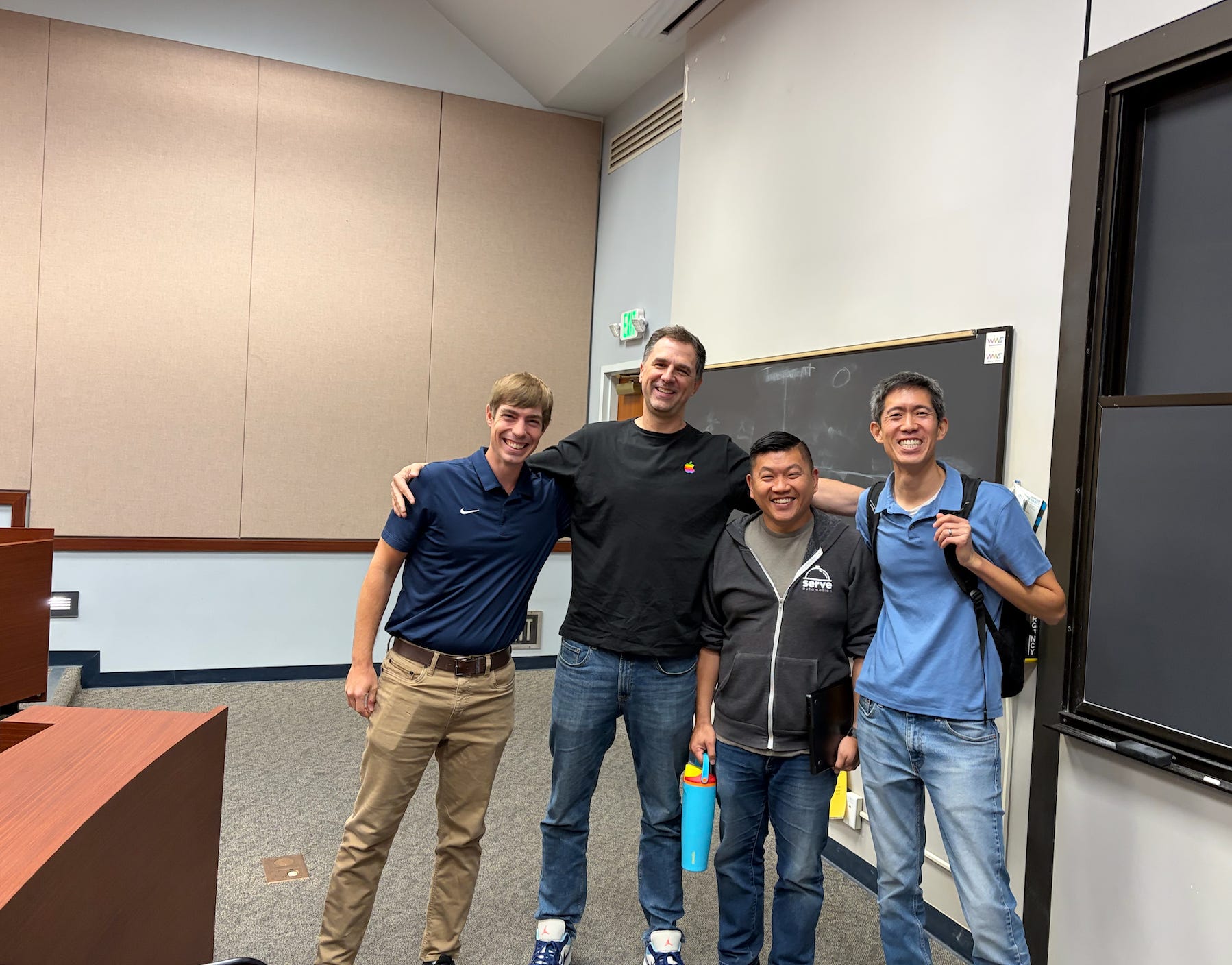
There just so happens to be a clash of the Josh’s and the Prof. Tsai’s on Monday and Wednesday mornings. Right after TJ and I wrap on our AI class, Josh Jones and Benson arrive to teach their entrepreneurship class. Seems like a collab in the making…
Great post, and great to see what you've been reading and what you've been up to!
For your Friday lunch on Microsoft's Humanist AI Code: we keep a public directory of the responses to it, from 14 Sept on, every piece read at source and sorted. It includes favourable readings, critical ones, and several written by AI systems themselves. It might give your students a wider field to argue with than the blog post alone: https://aiandbecoming.substack.com/p/microsofts-humanist-ai-code-of-conduct